Landscaping in Spring Valley mostly means converting thirsty lawn to desert landscape and rebuilding the twenty-year-old spray irrigation that came with it. If you own a single-family home, no law makes you do it. Nevada’s nonfunctional turf ban covers commercial and multi-family property, not houses. What pays for it is a rebate most people quote at the wrong number.
In Spring Valley the rate is $7 per square foot, not $5. The Southern Nevada Water Authority pays $5, and the Las Vegas Valley Water District adds $2 on top for its residential customers, which is $7 per square foot up to 10,000 square feet and $4.50 per square foot after that.
Updated August 31, 2026. Every rule and dollar figure below is attributed to the agency that publishes it, with the date we read it.
Spring Valley is one of the older parts of the west-central valley, and a lot of its yards were built in an era that assumed cheap water and wall-to-wall grass. That is why almost every job we take here is a conversion rather than a redesign. Las Vegas Landscape Pros spends most of its time in this neighbourhood taking tired lawns and failing sprinkler systems and rebuilding them into something that fits the desert and the current cost of water.
The call that has to happen before a single square foot comes out
SNWA states it plainly: after your application is completed you must participate in a pre-conversion site visit, and removing your lawn without approval will make your conversion ineligible. Not reduced. Ineligible.
On a 1,000 square foot front lawn in Spring Valley that is $7,000 lost to doing the right work in the wrong order. It is the most expensive avoidable mistake available in this neighbourhood, and the only thing standing between you and it is an appointment. SNWA also warns that applications rise in spring and autumn, which lengthens the wait for site visits, so the appointment is worth booking well before the crew is scheduled.
If you applied before 18 September 2025, you have to reapply
This one catches people who did everything right and then waited. LVVWD states that customers who applied before Sept. 18, 2025 and still have grass must reapply to receive the $7 rebate, and that SNWA will contact them for an additional site visit.
An old approved application sitting in a drawer is worth $5 a square foot. The same yard reapplied is worth $7. On 1,000 square feet that is $2,000 for filling in a form again. There is no published expiry date on the additional incentive, but the reapplication requirement is not optional for the higher rate.
The $2 bonus is funded by LVVWD’s excessive use charge, paid by the highest residential water users, so the money moving into a Spring Valley conversion comes from the valley’s heaviest irrigators.
Seven rules that decide a Spring Valley project
- The state turf law does not apply to single-family homes. Nevada’s 2021 law prohibits Colorado River water delivered by SNWA member agencies from irrigating nonfunctional grass on properties not zoned exclusively for single-family residences after January 1, 2027. SNWA states it does not apply to grass at single-family residences, front or back yard. If you own a house here, nobody is making you tear out your lawn. If you manage commercial, multi-family, government or HOA-managed property, the 2027 date is yours and the clock is real.
- The combined rebate is $7 per square foot up to 10,000 square feet, then $4.50. SNWA pays $5 per square foot of grass removed and replaced with desert landscaping; LVVWD adds $2 for its residential customers. Businesses, HOAs and multi-family properties are paid $5 per square foot for the first 10,000 square feet and $1.50 per square foot thereafter by SNWA.
- The minimum project is 400 square feet of lawn or water surface. SNWA says smaller projects may be accepted at its discretion where less than 400 square feet exists in the project area.
- You have 12 months to finish, measured from the pre-conversion inspection. SNWA may grant an extension of up to 90 days at its discretion. If the finished work does not meet programme conditions, you get 60 days from notice or the remainder of the 12 months, whichever is greater, to put it right.
- The converted area carries a conservation easement, recorded with Clark County, in perpetuity. The rebate is conditional on granting it, and it restricts certain uses of the converted area permanently. This is the term that most deserves reading before signing, because it runs with the land rather than with you.
- HOA and multi-family conversions over a quarter acre need written planning approval. Where the conversion area exceeds 10,890 square feet, business, HOA and multi-family properties must secure written approval from the local jurisdiction’s planning department as a condition of eligibility. In Spring Valley that catches a lot of common-area turf.
- Your HOA cannot make you keep grass. SNWA states that most government jurisdictions in the Las Vegas Valley have laws preventing an HOA from restricting the installation of a water-saving landscape: an HOA may require you to submit landscape design plans for approval, but it cannot require you to install grass and cannot prohibit water-efficient landscapes. It may restrict some types of landscape material.
What the money looks like on a real Spring Valley yard
| Lawn removed | SNWA at $5 | LVVWD bonus at $2 | Total rebate |
|---|---|---|---|
| 400 sq ft (programme minimum) | $2,000 | $800 | $2,800 |
| 800 sq ft | $4,000 | $1,600 | $5,600 |
| 1,500 sq ft | $7,500 | $3,000 | $10,500 |
| 3,000 sq ft | $15,000 | $6,000 | $21,000 |
Add $100 per new tree under the Tree Enhancement Program, up to 100 percent canopy coverage. SNWA’s own guidance is that for most participants the rebate pays about half the cost of a good-quality conversion, and as much as 75 percent for some. It also notes that rebates may be considered taxable income, which is a question for your tax adviser rather than your landscaper.
The specification the inspection actually checks
A conversion is not finished when the grass is gone. SNWA inspects against programme conditions, usually within 10 business days of you reporting completion, and these are the ones that fail projects:
- Drip irrigation with a filter, a pressure regulator, and emitters rated at 20 gallons per hour or less. The filter is not optional decoration; emitter openings are small enough that sediment closes them.
- The system must be free of malfunctions and leaks, and the required components must be visible for the inspection. Burying the filter and regulator is a re-visit.
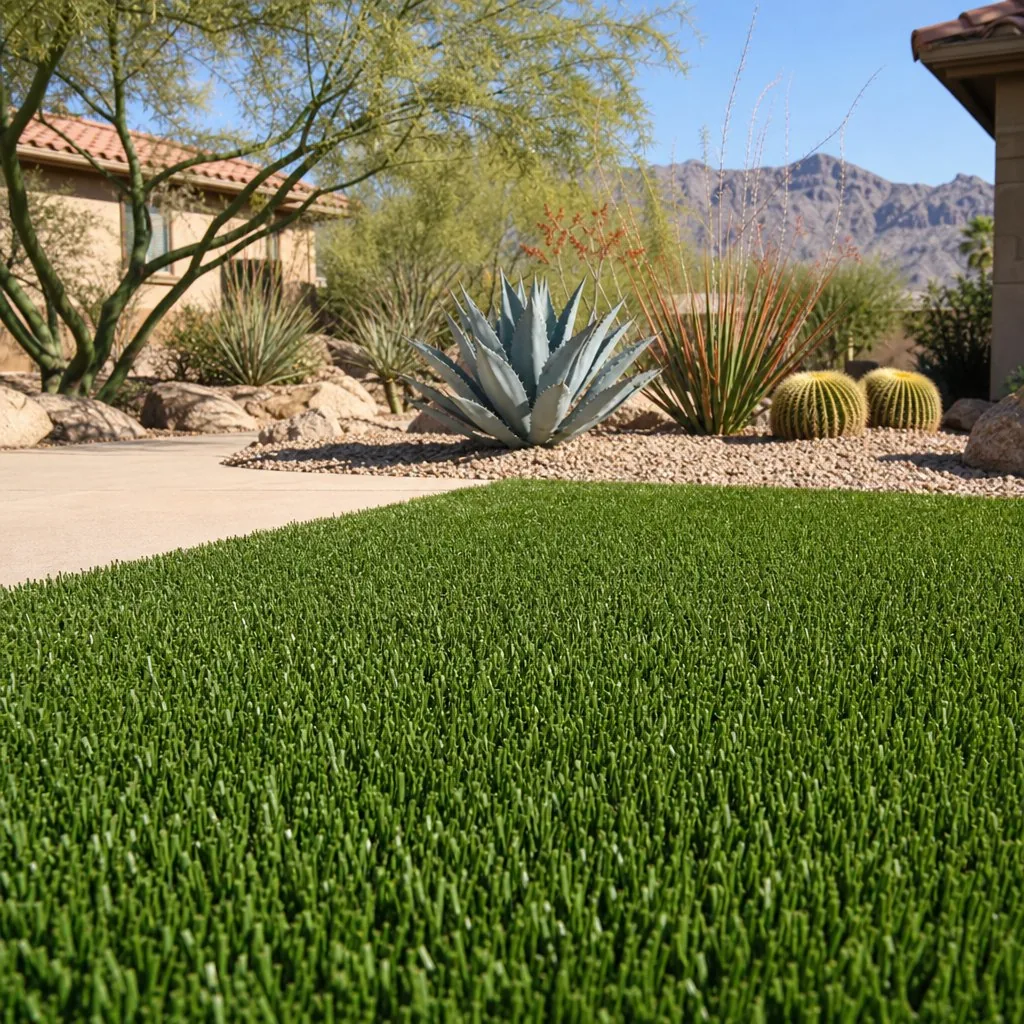
- 50 percent canopy coverage from the plant palette at maturity. If artificial turf is part of the conversion, existing plants outside the lawn conversion area can be counted toward it.
- Tree Enhancement trees need a minimum canopy value of 236 square feet, which is at least a 20-foot canopy at maturity, in an ANSI-Z60 #15 container or larger, at least 5 feet tall, with a 1 to 2 inch caliper.
Once the easement is recorded with Clark County, SNWA states the rebate cheque is processed and mailed generally within 10 business days of the recording.
Lawn conversions done properly
A conversion is more than killing grass and dumping rock on it. We remove the turf and its thatch layer, correct the grade the old lawn was hiding, install new irrigation, and then build the desert design on a clean base. Skipping the grade is the mistake that shows up two monsoons later, when the rock has migrated to the low corner and the drip line is sitting on the surface.
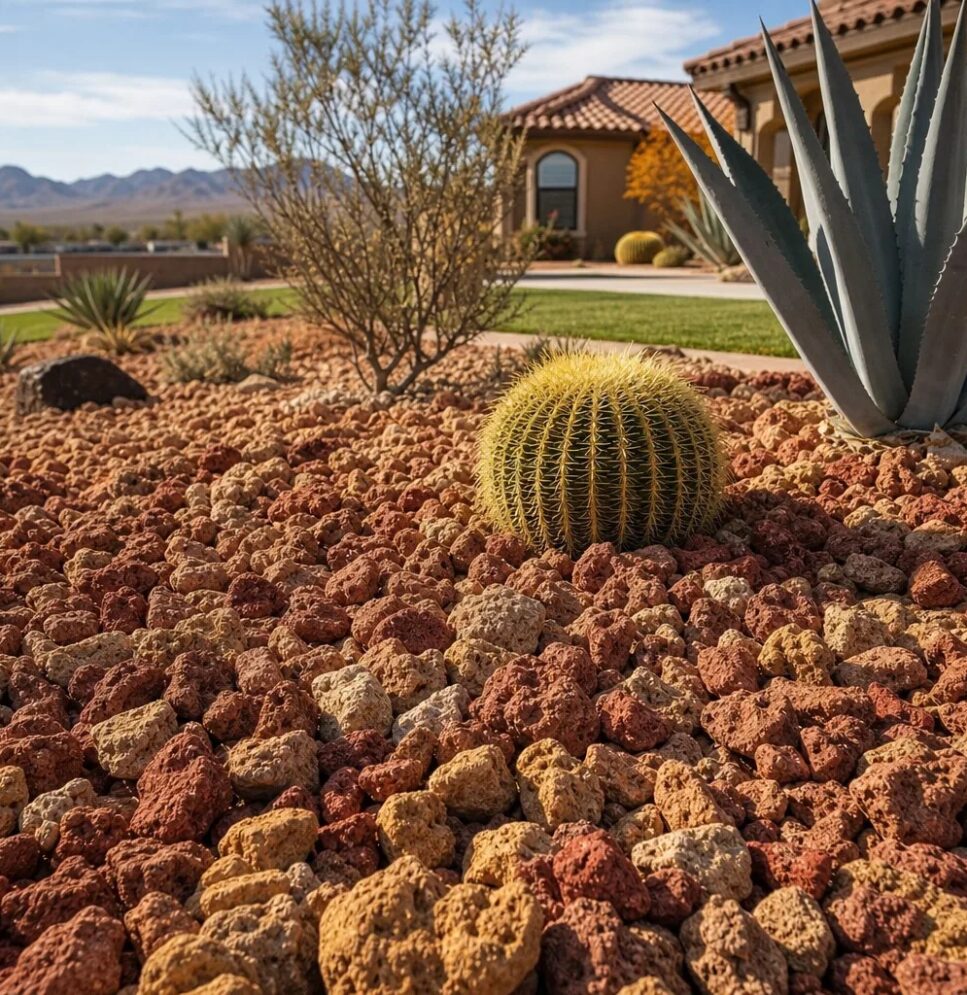
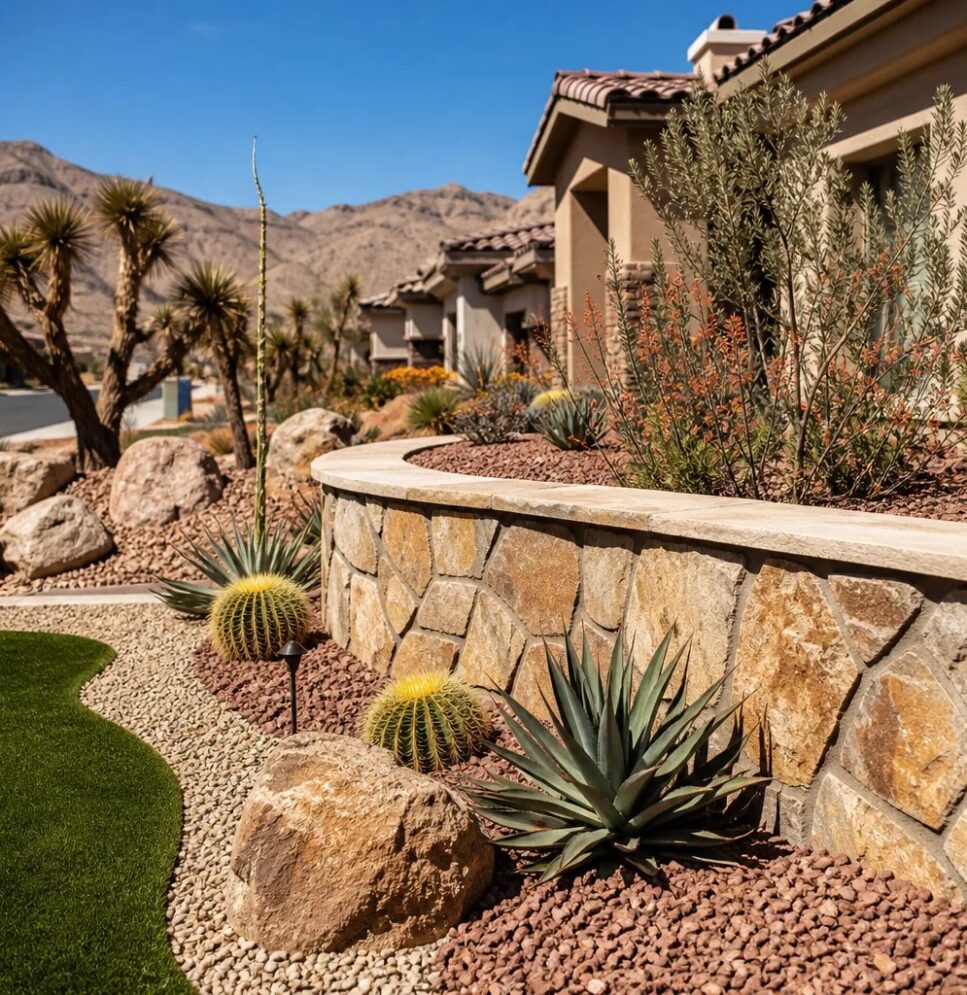
The replacement is real desert landscaping: structure from boulders and grade, plant layers of Texas ranger, red yucca and desert marigold, and decomposed granite sized and edged so it stays put.
You are also not obliged to remove all of it. SNWA describes functional lawn areas as one of the seven principles of water smart landscaping, and says some conversion projects simply create a buffer around the edge of an existing lawn. Nor do you have to hire from SNWA’s Water Smart Landscaper list; that list is contractors who are licensed, bonded and have attended Water Authority training, and you may use anyone or do it yourself.
Old sprinkler systems on their last season
Twenty-year-old spray systems in Spring Valley usually have broken heads, mismatched nozzles and a controller nobody has adjusted in years. We replace them with zoned drip irrigation that delivers water at the root instead of into the air, and set seasonal schedules so summer and winter are not treated the same. Because the assigned watering group is fixed by address and the mid-day window is closed through August 31, the controller has to be programmed around both at once.
Mature trees worth keeping
The upside of an older neighbourhood is canopy. We keep established ash, mesquite and pine structurally sound with tree trimming that removes deadwood and reduces end-weight before summer wind finds the weak limb. Trees are also the part of a conversion people most often get wrong: pull the lawn without giving the tree its own deep zone at the dripline and you lose a canopy that took thirty years to grow, to save water on a lawn that was leaving in any case.
Frequently asked questions
Do I have to remove my lawn in Spring Valley? Not if you own a single-family home. SNWA states the nonfunctional grass law does not apply to grass at single-family residences, front or back yard. It applies from January 1, 2027 to properties not zoned exclusively for single-family residences. Homeowners here convert because of the rebate and the water bill, by choice.
How much does the turf rebate actually pay in Spring Valley? $7 per square foot for LVVWD residential customers, made up of $5 from SNWA and an additional $2 from the Las Vegas Valley Water District, up to 10,000 square feet, and $4.50 per square foot after that.
Do I need approval before removing my grass? Yes, and this is the condition that voids rebates. After the application is completed you must take part in a pre-conversion site visit, and SNWA states that removing your lawn without approval will make your conversion ineligible.
I applied a while ago. Do I still get the $7 rate? Not automatically. LVVWD states that customers who applied before September 18, 2025 and still have grass must reapply to receive the $7 rebate, and that SNWA will contact them for an additional site visit.
Is there a minimum size before the rebate applies? Yes. At least 400 square feet of lawn or water surface has to be converted, though SNWA says it may accept smaller projects at its discretion where less than 400 square feet exists in the project area.
How long do I have to finish the conversion? Twelve months from the pre-conversion inspection, with a possible extension of up to 90 days at SNWA’s discretion. If the work does not meet programme conditions, corrective action gets 60 days from notice or the remainder of the twelve months, whichever is greater.
What is the conservation easement? The rebate is subject to the property owner granting a conservation easement, recorded with Clark County, that restricts certain uses of the converted area in perpetuity. It runs with the property rather than with the current owner, so read it before signing.
Can my HOA stop me converting to desert landscaping? SNWA states that most government jurisdictions in the Las Vegas Valley have laws preventing an HOA from restricting the installation of a water-saving landscape. An HOA may require you to submit landscape design plans for approval, but it cannot require you to install grass or prohibit water-efficient landscapes, though it may restrict some types of landscape material.
Our HOA wants to convert the common area. Is anything different? Yes. Where the conversion area is greater than 10,890 square feet, roughly a quarter acre, HOA, business and multi-family properties must get written approval from the local jurisdiction’s planning department as a condition of rebate eligibility. Start that approval early, because it gates the money rather than following it.
What irrigation does the rebate require? Drip irrigation including a filter, a pressure regulator and emitters rated at 20 gallons per hour or less, free of malfunctions and leaks, with the required components visible for inspection.
Is the rebate cheque taxable? SNWA states rebates may be considered taxable income and recommends consulting a tax adviser.
Can I put in a new bermudagrass lawn instead? Not common bermudagrass. It cannot be planted in Clark County because of allergies from its pollen production, according to University of Nevada, Reno Extension. Hybrid bermudagrass, zoysiagrass, buffalograss, seashore paspalum and St. Augustine are named as warm-season options for the urban Mojave Desert, and turf-type tall fescue is the cool-season grass that tolerates the summer here best.
What days can I water in Spring Valley? Your day depends on your assigned watering group, which SNWA assigns by address. Two rules apply on top of the group schedule: no landscape watering on Sundays at any time of year, and no watering between 11 a.m. and 7 p.m. through August 31.
Sources
Rebate amounts, pre-conversion approval, minimum project size, deadlines, conservation easement, irrigation specification and the Tree Enhancement Program: SNWA Water Smart Landscapes, snwa.com/rebates/wsl. Read 2026-08-31. The additional $2 per square foot, the combined $7 and $4.50 rates and the reapplication requirement for applications before September 18, 2025: Las Vegas Valley Water District, lvvwd.com/conservation/rebates. Read 2026-08-31. Nonfunctional grass law, the single-family exclusion and the HOA position: SNWA, snwa.com/conservation/understand-laws-ordinances. Read 2026-08-31. Watering group, Sunday prohibition and seasonal hours: SNWA, snwa.com/conservation/watering-group. Read 2026-08-27. Grass species and the Clark County bermudagrass restriction: University of Nevada, Reno Extension FS-11-54, extension.unr.edu. Read 2026-07-30.
Method note: rebate rates, deadlines and programme conditions change, and SNWA states the rebate is paid at the rate in place when the project is complete. Confirm your own rate and conditions with SNWA and LVVWD before budgeting. Nothing on this page is a service quote.
Get a free quote
A site review here should account for Mojave Desert heat and monsoon pulses, and for caliche, alkaline fill and sharply draining desert soil, all of which change irrigation, grading and plant establishment decisions. We document those conditions, confirm which SNWA and Las Vegas Valley Water District rules apply to your address, and separate the confirmed work from the options still waiting on your approval.
We cover the west-central valley including Enterprise and Summerlin, and serve the wider Las Vegas Valley.
What does landscaping in Spring Valley usually involve?
In Spring Valley it mostly means converting thirsty lawn to desert landscape and rebuilding the twenty-year-old spray irrigation that came with it. Single-family homeowners face no legal requirement, since Nevada’s nonfunctional turf ban covers commercial and multi-family property. A rebate pays for the work, and Las Vegas Landscape Pros quotes it at the correct rate.
Is a homeowner required to remove grass in Spring Valley?
No law forces a single-family homeowner to pull grass, since Nevada’s nonfunctional turf ban covers commercial and multi-family property, not houses. The rebate pays $7 per square foot, $5 from the Southern Nevada Water Authority plus $2 from the Las Vegas Valley Water District. Las Vegas Landscape Pros rebuilds Spring Valley lawns and spray irrigation across Las Vegas.