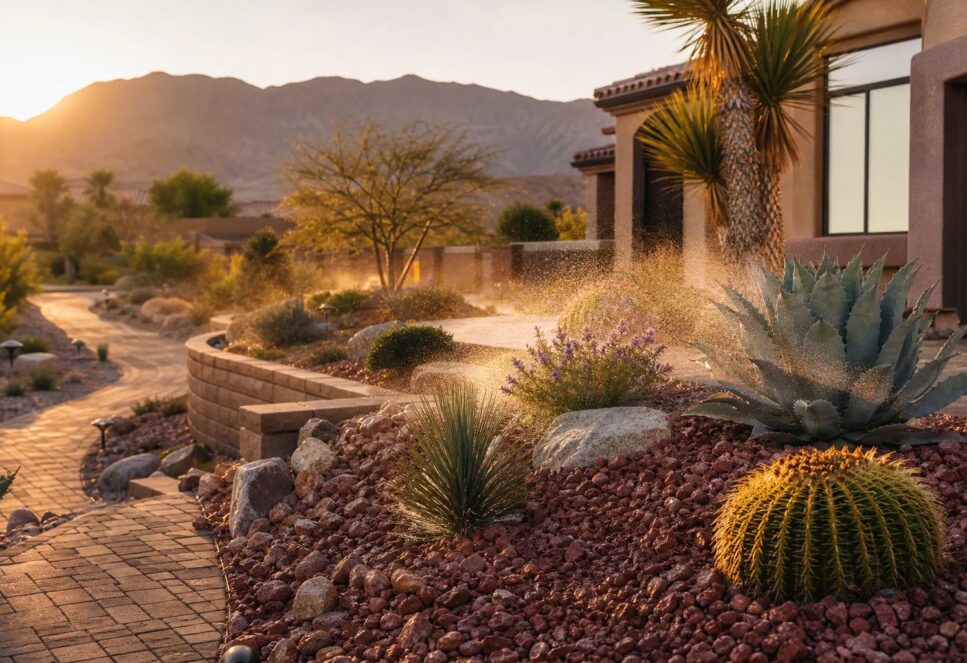
Drip irrigation delivers water at low pressure directly to plant roots, slowly enough for the soil to absorb it, with nothing sprayed into the air and nothing landing on pavement. In the Las Vegas Valley it is the standard irrigation method for desert landscapes — and under the Southern Nevada Water Authority’s rules it is also the method with the most generous watering allowance.
The SNWA’s rules treat sprinklers and drip very differently, and the gap is instructive. Sprinkler watering is assigned by address group, prohibited between 11 a.m. and 7 p.m. from May through August, and prohibited on Sundays year-round. Drip irrigation is permitted up to four days per week, in sessions of roughly 30 to 90 minutes.
That difference exists because the two methods are not comparable in efficiency. In dry Mojave air a real fraction of what a sprinkler throws evaporates or drifts before reaching the soil, and what does land is spread uniformly — including across ground with nothing growing in it. Drip puts water at the root zone of specific plants at a rate the ground can take, so almost all of it is used.
There is also a direct connection to AB356. As decorative turf comes out across the valley ahead of the December 31, 2026 deadline, the landscapes replacing it are planted rather than grassed — and planted areas are what drip is built for. Most conversions therefore involve reworking the irrigation, not just changing what grows.
Backflow prevention. The tie-in to your supply includes backflow protection so irrigation water cannot be drawn back toward the potable side.
Filter and pressure regulator. This pair determines whether the system survives. Emitters operate at low pressure and block easily; unregulated household pressure blows fittings apart, and unfiltered grit clogs emitters internally. Both components are cheap, and both are frequently absent from systems we are called to repair.
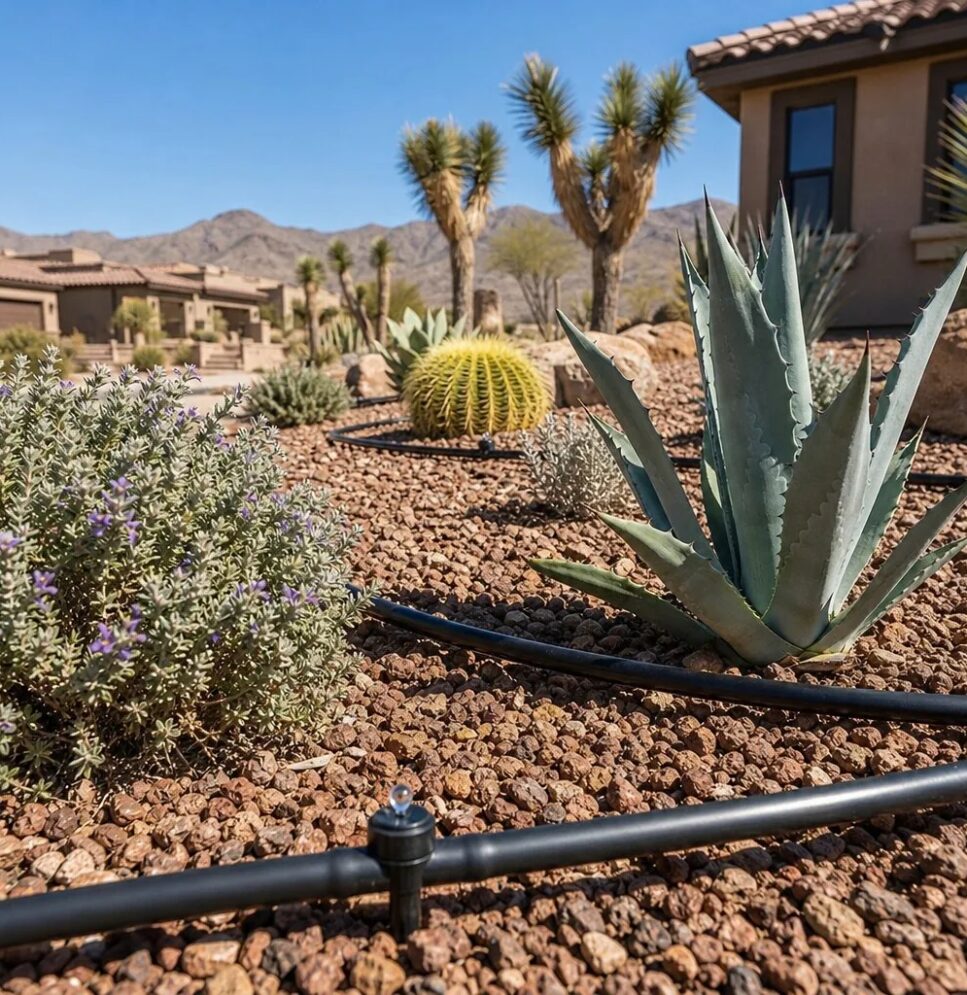
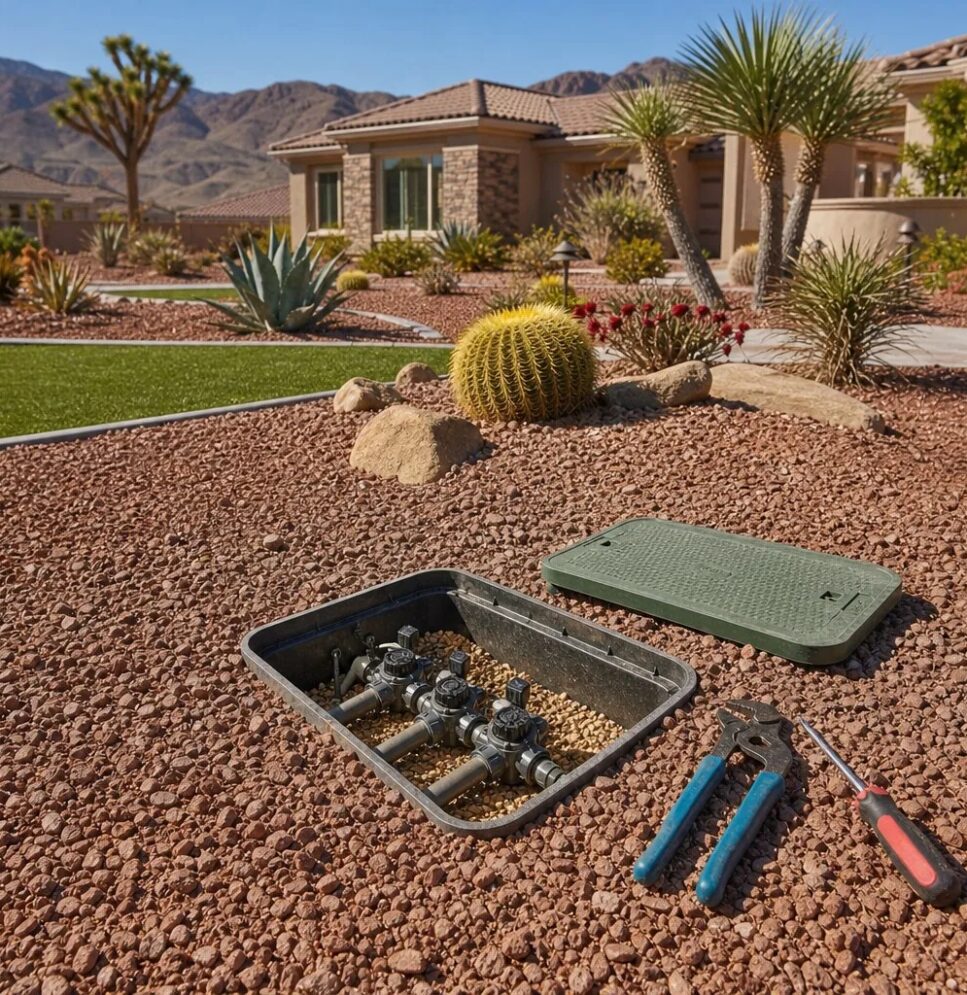
Tubing and emitters. Main line runs the length of a bed with feeder tubing to individual plants. Emitters are rated by flow, so a new shrub and an established tree can share a line and still each receive an appropriate amount.
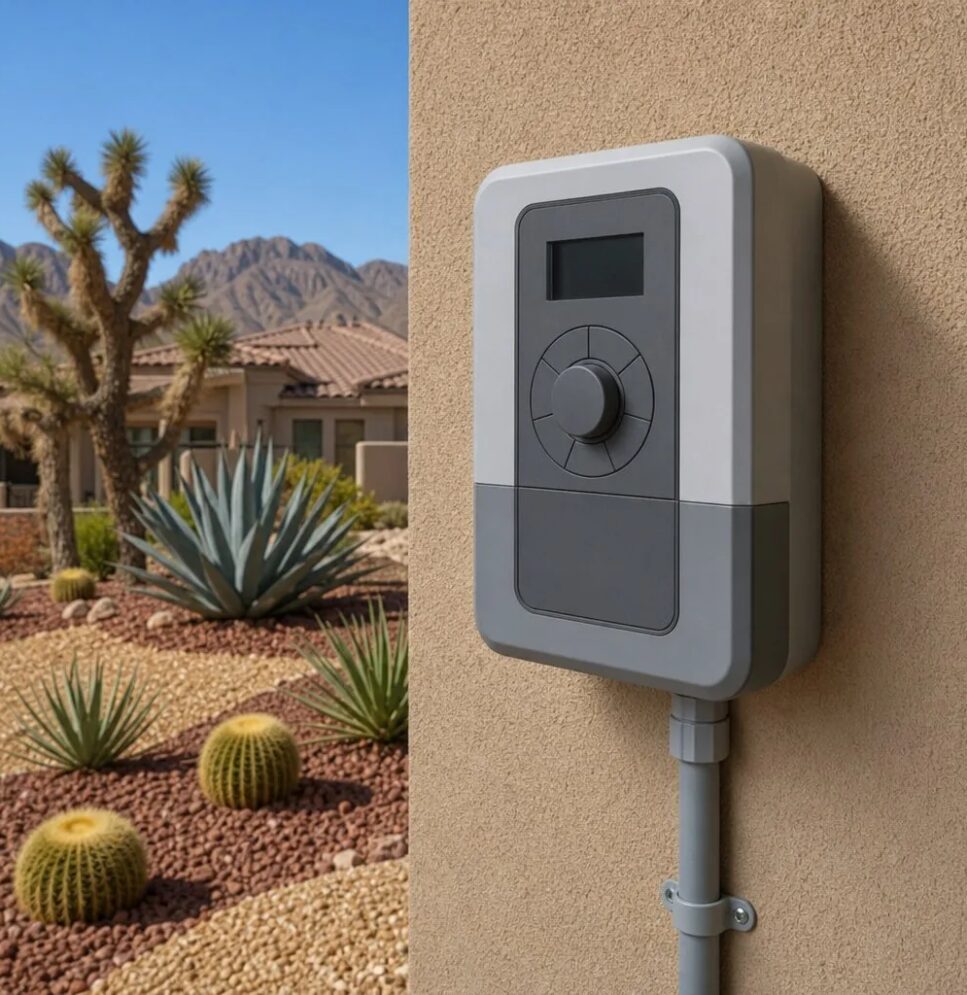
Zones and controller. Plants with genuinely different requirements belong on separate zones with separate run times. The controller executes that reliably, which manual watering never manages across a valley summer.
Scheduling — where the water is actually saved
Most of the water wasted by an efficient system is lost to scheduling rather than to hardware. The instinct is frequent short cycles; the desert rewards the opposite. Deep, infrequent watering wets the full root depth and drives roots downward, and deep roots are what carry a plant through July. Frequent shallow watering produces shallow roots and a plant with no reserve.
The four-day drip allowance gives ample room to build a genuinely deep schedule without approaching the limit. Seasonal adjustment then matters just as much: a schedule appropriate to June is wrong in January, and a controller left on summer settings through winter wastes water continuously and invisibly.
Cost depends on the area covered, the number of zones, the count and type of emitters, whether this is a new installation or a retrofit of existing sprinkler zones, and the controller and backflow provisions required. Trenching adds labour, and caliche adds more of it. Retrofits are often faster than new installations because valves and buried supply lines are already in place. A single bed converted to drip is a modest job; a whole-property multi-zone system is a substantially larger one. We quote after seeing the site.
Timeline
A residential installation or sprinkler-to-drip conversion typically takes one to a few days, depending on zone count and trenching. Commissioning is part of the work rather than an afterthought: every zone is run, every emitter checked, and the controller programmed and explained before we finish.
Drip is the right tool for beds, desert plantings, shrubs, cacti, and trees — which in a post-conversion valley yard is nearly everything. It is not the right tool for a functional turf area, which needs uniform coverage across a continuous surface. Many properties end up running both: drip across all planted areas, with conventional irrigation retained only on turf that is genuinely used.
Local constraints: SNWA watering rules and AB356
The Southern Nevada Water Authority assigns watering days by address group, prohibits sprinkler irrigation between 11 a.m. and 7 p.m. from May through August, and prohibits sprinkler watering on Sundays year-round. Drip irrigation is allowed up to four days per week in sessions of roughly 30 to 90 minutes. Separately, Nevada AB356 requires nonfunctional (decorative) turf in the Las Vegas Valley to be removed by December 31, 2026, with use prohibited from January 1, 2027 — and efficient irrigation is the standard for the landscapes that replace it. (Sources: Southern Nevada Water Authority; Nevada AB356.)
Drip fails quietly, which is its one real drawback. A broken sprinkler is obvious; a clogged emitter simply stops, and the first sign is usually a dead plant weeks later. A brief seasonal routine prevents nearly all of it: flush the lines, clean the filter, run each zone and walk it, and replace emitters that have stopped or are running away. Tubing pulled loose by root growth or garden work is the other common fault — easy to spot while a zone runs, invisible when it does not.
Frequently asked questions
How many days a week can I run drip in Las Vegas? SNWA rules allow drip irrigation up to four days per week, in sessions of roughly 30 to 90 minutes — a more generous allowance than sprinkler watering receives.
Do the sprinkler restrictions apply to drip? The 11 a.m. to 7 p.m. May-to-August restriction and the year-round Sunday prohibition are directed at sprinkler irrigation. Drip is governed by its own allowance, which is why converting is worthwhile on compliance grounds alone.
Can you convert my sprinklers to drip? Yes, and it is one of the most common jobs in the valley right now, particularly alongside AB356 turf conversions. Existing valves and supply lines are generally reused.
How long should a zone run? Longer and less often than most people assume. The aim is to wet the full root depth, then let the soil dry before the next cycle.
Is a pressure regulator essential? On essentially every residential system, yes. Without one, emitters and fittings fail early. With a filter, it is the cheapest reliability available.
Will the tubing be visible? It is normally run beneath the rock or mulch layer, so the finished bed shows plants and ground cover rather than hardware.
Sources
Southern Nevada Water Authority — watering rules and Nevada AB356 turf requirements: snwa.com.
Map a drip-irrigation correction with Mojave soil constraints
How do Southern Nevada Water Authority rules treat drip irrigation compared with sprinklers?
The Southern Nevada Water Authority's rules treat sprinklers and drip very differently, and drip carries the most generous watering allowance, making it the standard irrigation method for desert landscapes in the valley. Las Vegas Landscape Pros designs and installs irrigation for desert landscapes across Las Vegas under those rules.
Get a Free Quote
Describe the Mojave property priorities and the areas included in the request.
Set the Priorities for This Mojave Project
Identify the hot spots, water zones, access, and maintenance goals so the Las Vegas work can be estimated against a clear brief.
Get a Free QuoteFrequently Asked Questions
How should drip irrigation las vegas account for a Las Vegas property's water budget?
Begin by separating planted, turf, hardscape and runoff areas, then document how each irrigated zone is intended to operate. The drip irrigation las vegas recommendation should show which water demand it changes and which existing demand remains.
Where does reflected heat matter on this Las Vegas drip irrigation las vegas project?
Walls, pavement and west-facing exposures can create different conditions within one property. Mark those surfaces during the site walk and evaluate materials or planting locations against the measured exposure rather than a citywide rule of thumb.
What evidence belongs in a Las Vegas drip irrigation las vegas proposal?
Include a site sketch, measured quantities, irrigation observations, preparation details, named materials, exclusions and a cleanup plan. The proposal should connect every major action to a visible condition or owner priority.