Desert Landscaping in Las Vegas, NV
Desert landscaping replaces decorative grass with drought-adapted plants, permeable ground cover, and efficient drip irrigation suited to the Mojave Desert. In the Las Vegas Valley it is not only the lowest-water way to keep a property attractive — for a great deal of existing decorative turf, converting is now a legal requirement with a fixed deadline.
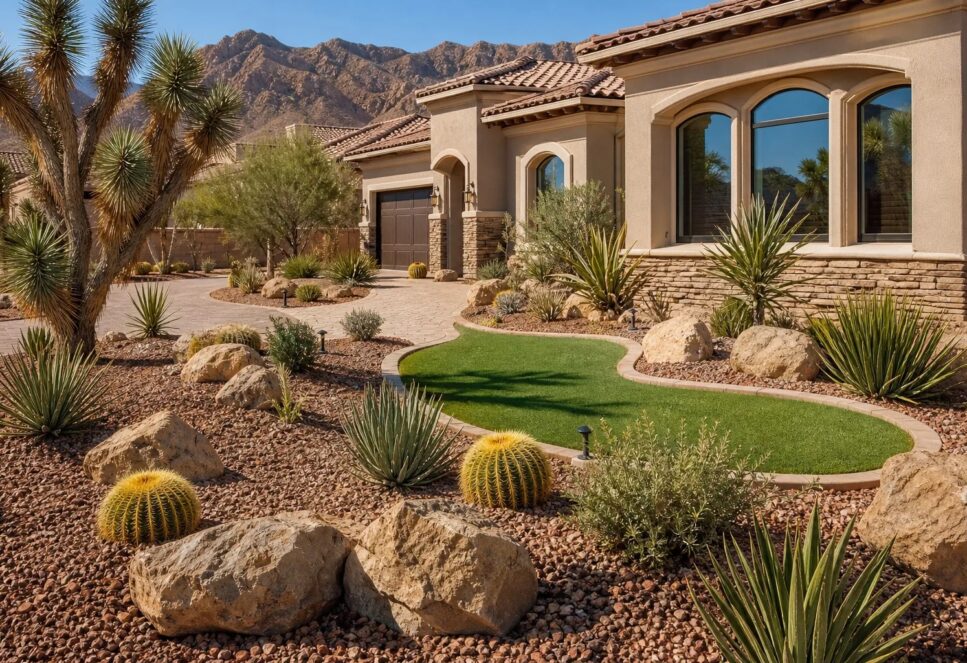
Under Nevada Assembly Bill 356, nonfunctional — that is, decorative — turf in the Las Vegas Valley must be removed by December 31, 2026, and its use is prohibited beginning January 1, 2027. That single fact reshapes the calculation for a large number of valley properties. Grass that exists purely to be looked at, rather than to be used, is on a countdown.
The water rules reinforce it. The Southern Nevada Water Authority assigns watering days by address group, prohibits sprinkler irrigation between 11 a.m. and 7 p.m. from May through August, and prohibits sprinkler watering on Sundays year-round. Drip irrigation, by contrast, is permitted up to four days a week in sessions of roughly 30 to 90 minutes — a materially more generous allowance, and one that reflects how much more efficiently drip delivers water.
A desert landscape is designed around all of that from the outset instead of working against it.
Turf removal and haul-off. Grass and root mass are removed rather than buried. Incomplete removal is why converted yards sprout grass through their rock the following season.
Grading and drainage. Mojave rain is infrequent and intense. Correct fall, shallow swales, and basins around plantings decide whether a storm irrigates the landscape or scours it toward the street.
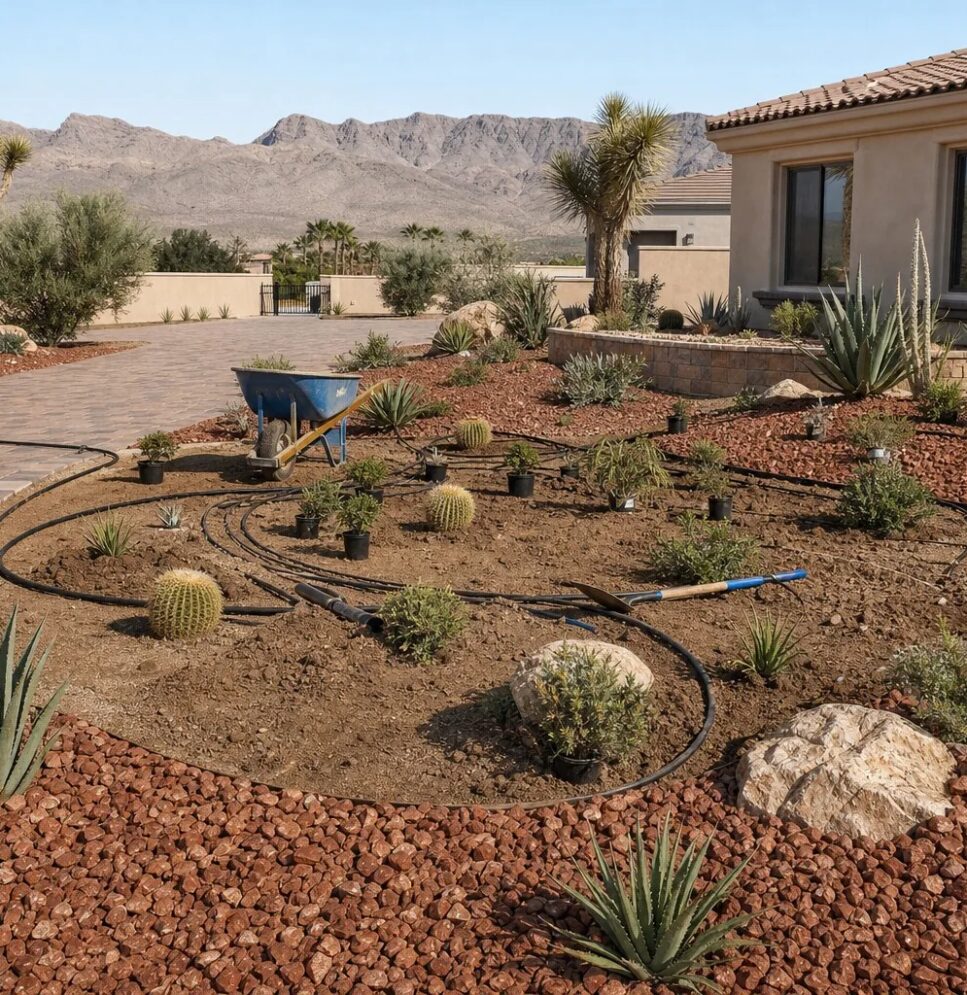
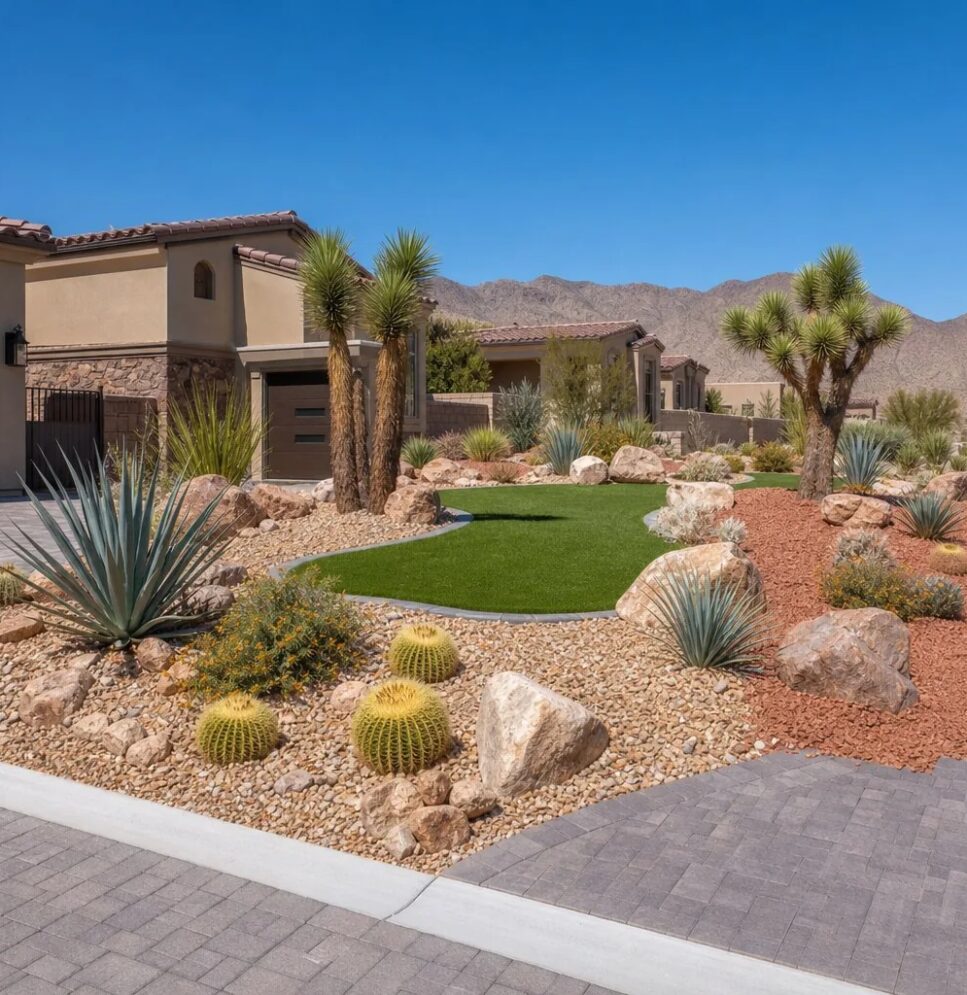
Irrigation conversion. Spray heads come out and drip goes in, zoned by plant water requirement so establishing and mature plants are not sharing one schedule.
Edging and ground cover. Edging holds the boundaries between materials. Rock or decomposed granite is placed deep enough to genuinely suppress germination rather than merely cover soil.
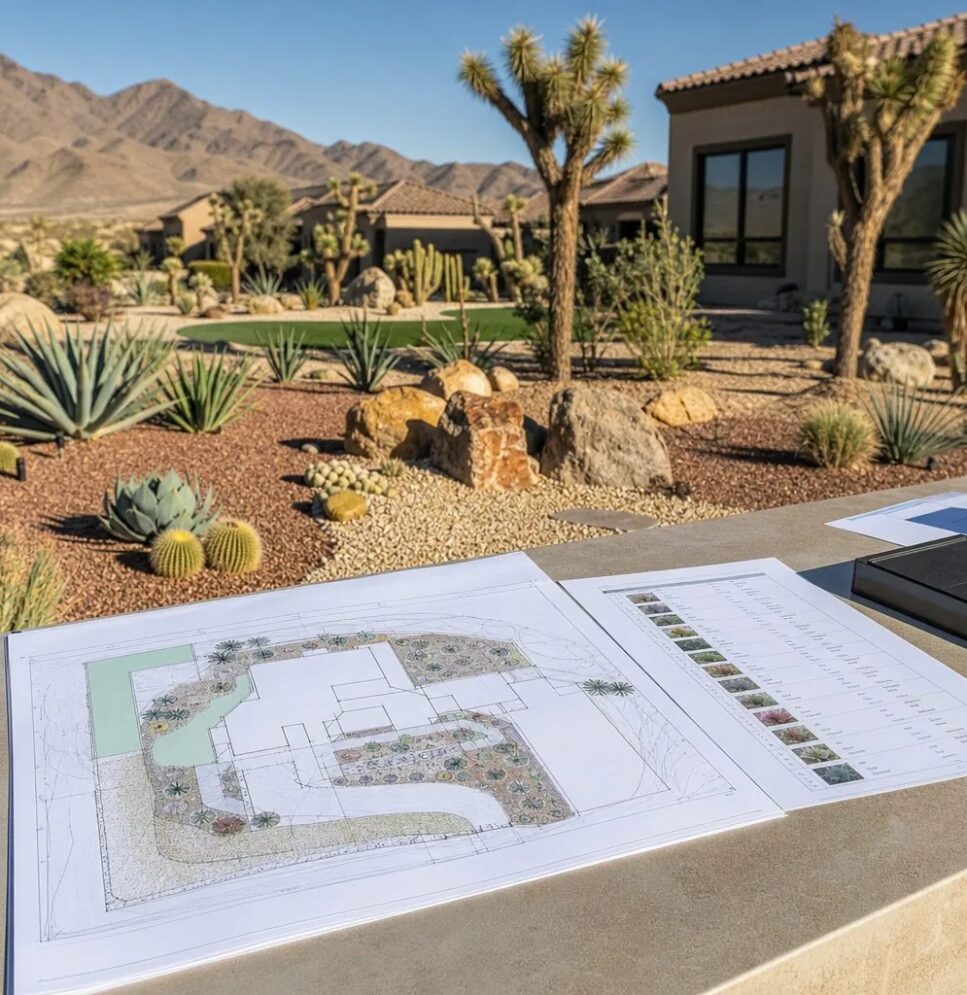
Las Vegas installation sequencing. Before plants arrive, verify the final hardscape edges and test every irrigation point serving the new beds. Set specimens from the approved layout, preserve the specified root flare elevation, and document substitutions individually; the closeout drawing should match what was installed, not the preliminary concept.
Design that works in the Mojave
Layering is what separates a desert landscape from a rock field. Desert trees supply the canopy that makes a yard usable in July and lowers the water demand of everything beneath them. Structural shrubs carry the composition through the year, and accents, cacti, and succulents provide form and seasonal colour.
The failure mode to avoid is a large, unshaded expanse of rock with a few plants scattered through it. It stores and radiates heat back toward the house, glares, and never reads as finished. The extra water needed to support proper planting density is small; the difference in the result is not.
Cost depends on the area converted, how much turf and hardscape must be removed and hauled away, how much grading the drainage needs, the plant and ground-cover selection, and the extent of the irrigation conversion. Access is a genuine factor, since rock is heavy and all of it must reach the work area by whatever route the property offers. Boulders, custom hardscape, and larger specimen plants raise the total; phasing a large conversion across seasons spreads it. We quote on site, because these variables move independently on every property.
Timeline
A typical residential conversion runs from a few days to a couple of weeks depending on What’s included: removal and haul-off, grading, irrigation, edging and ground cover, then planting. With the AB356 deadline fixed at December 31, 2026, earlier is straightforwardly better — demand on conversion work concentrates as a deadline approaches, and a property converted well ahead of it is simply finished.
If you have decorative grass covered by AB356, conversion is not optional and desert landscaping is the natural compliant path. If your grass is functional — genuinely used by people or pets — the calculation is different, and a partial conversion is usually the right answer: retain the usable turf area, convert everything that exists only to be looked at. That concentrates both your water and your compliance effort where they belong.
Local constraints: AB356 and the SNWA watering rules
Nevada Assembly Bill 356 requires nonfunctional (decorative) turf in the Las Vegas Valley to be removed by December 31, 2026, with its use prohibited from January 1, 2027. Alongside that, the Southern Nevada Water Authority assigns watering days by address group, prohibits sprinkler irrigation between 11 a.m. and 7 p.m. from May through August, and prohibits sprinkler watering on Sundays year-round. Drip irrigation is allowed up to four days per week, in sessions of roughly 30 to 90 minutes. A desert landscape on drip lives comfortably inside every one of these constraints. (Sources: Nevada AB356 and the Southern Nevada Water Authority.)
Plant and grass notes for the valley
If any turf is being retained, the species question matters here in a way it does not elsewhere. University of Nevada, Reno Extension guidance notes that common bermudagrass cannot be planted in Clark County because of allergies caused by its pollen. Among cool-season grasses, tall fescue tolerates desert summer heat the best and establishes readily from seed, and turf-type tall fescue has proven the most popular lawngrass in the Mojave Desert transition zone. Warm-season grasses identified for urban Mojave landscapes include hybrid bermudagrass, zoysiagrass, buffalograss, seashore paspalum and St. Augustine grass.
Timing follows from that. Extension guidance indicates warm-season grasses are established from seed or sprigs from April through June, with sod extending that window by roughly a month into early August, while cool-season grasses prefer the cooler months — February through March, and mid-September through mid-October.
A desert landscape needs attention, just far less of it. Rock and granite are topped up where they thin or where a storm has shifted them, weeds are pulled before they seed, shrubs and accents are pruned annually to hold form, and drip emitters are checked seasonally for clogs and breaks. A broken emitter that goes unnoticed is the most common cause of both a dead plant and an unexplained water bill.
Frequently asked questions
What counts as nonfunctional turf under AB356? The law targets decorative grass — turf that exists to be looked at rather than used. Grass serving a genuine recreational or functional purpose is treated differently, which is why properties frequently convert some areas and retain others.
When is the deadline? Nonfunctional turf in the Las Vegas Valley must be removed by December 31, 2026, and its use is prohibited beginning January 1, 2027.
Does a desert landscape still need water? Yes, particularly through the first establishment season. After that, desert-adapted plants need only occasional deep watering — and drip is permitted up to four days a week, so scheduling is comfortable.
Can I keep some grass? Yes, where it is functional. Partial conversion is extremely common and is usually the best outcome for a family property.
Will the yard look bare? Only if it is under-planted. Layered trees, shrubs, accents, and cacti give a Mojave landscape genuine year-round structure.
What happens to my sprinkler system? In a conversion the spray heads are removed and the system is reworked to drip, which is both more efficient and subject to a more generous watering allowance than sprinklers.
Sources
Southern Nevada Water Authority — watering rules and Nevada AB356 turf requirements: snwa.com. University of Nevada, Reno Extension — turfgrasses for urban Mojave Desert landscapes (FS-11-52) and lawn establishment in the Mojave Desert (FS-11-54): extension.unr.edu.
Plan a desert-landscape conversion with Mojave soil constraints
How much does landscaping cost in Las Vegas?
Cost varies with the area converted, how much turf and hardscape must be removed and hauled away, the grading the drainage needs, the plant and ground-cover selection, and how extensive the irrigation conversion is. Access matters too, since rock is heavy and must reach the work area. Las Vegas Landscape Pros prices each of these per property.
Get a Free Quote
Describe the Mojave property priorities and the areas included in the request.
Set the Priorities for This Mojave Project
Identify the hot spots, water zones, access, and maintenance goals so the Las Vegas work can be estimated against a clear brief.
Get a Free QuoteFrequently Asked Questions
How should neighborhood property planning account for a Las Vegas property's water budget?
Begin by separating planted, turf, hardscape and runoff areas, then document how each irrigated zone is intended to operate. The neighborhood property planning recommendation should show which water demand it changes and which existing demand remains.
Where does reflected heat matter on this Las Vegas neighborhood property planning project?
Walls, pavement and west-facing exposures can create different conditions within one property. Mark those surfaces during the site walk and evaluate materials or planting locations against the measured exposure rather than a citywide rule of thumb.
What evidence belongs in a Las Vegas neighborhood property planning proposal?
Include a site sketch, measured quantities, irrigation observations, preparation details, named materials, exclusions and a cleanup plan. The proposal should connect every major action to a visible condition or owner priority.