
Hardscaping in Las Vegas means patios, walls, walkways and shade structures, and much of it triggers a permit or a Nevada contractor license before the first shovel goes in. This guide covers who needs what, how to scope it, and how to hire safely. Call (702) 766-4082 or request a free quote to talk through your yard.
What counts as hardscaping in a Las Vegas yard?
Hardscaping is every non-living, built element of a yard: patios, pavers, flagstone paths, block walls, retaining walls, fire pits, steps, shade structures and edging. In the Las Vegas Valley it usually sits beside rock and drip-irrigated plantings, and each piece carries its own permit and drainage questions.
The word gets stretched a lot online, so it helps to sort your wish list into three buckets before you call anyone. Flat surfaces are the first bucket: a poured or paver patio, a walkway, a pad for a grill or a spa. Vertical pieces are the second: freestanding block walls, planter walls, seat walls and retaining walls that hold back soil. Overhead and fixed features make up the third: patio covers, ramadas, pergolas, shade sails, built-in fire features and anything that ties into the house.
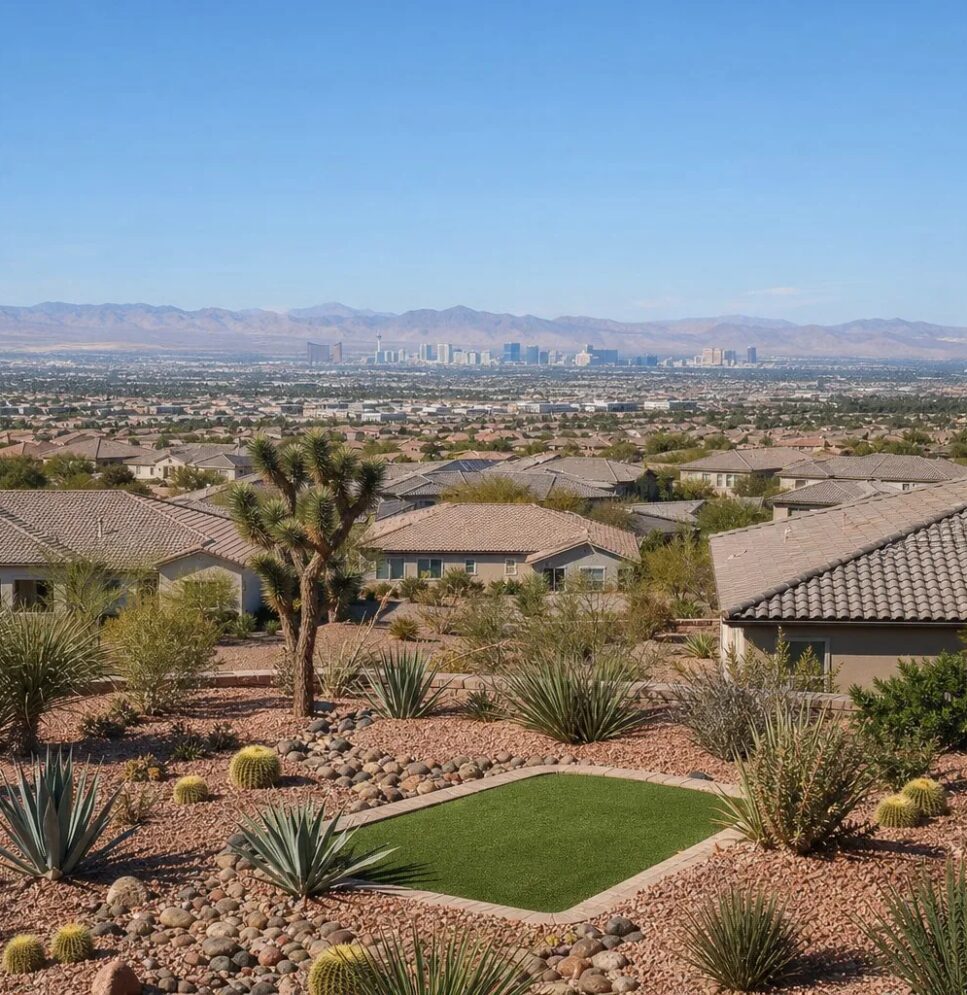
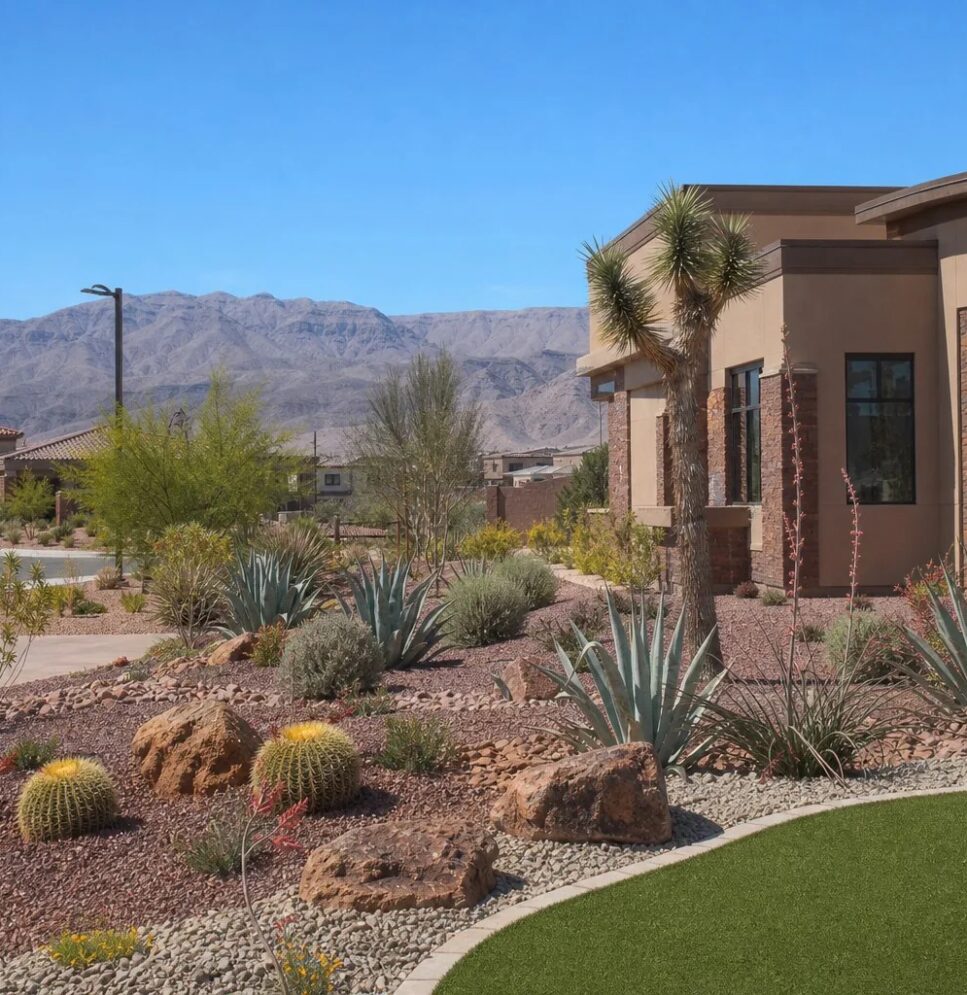
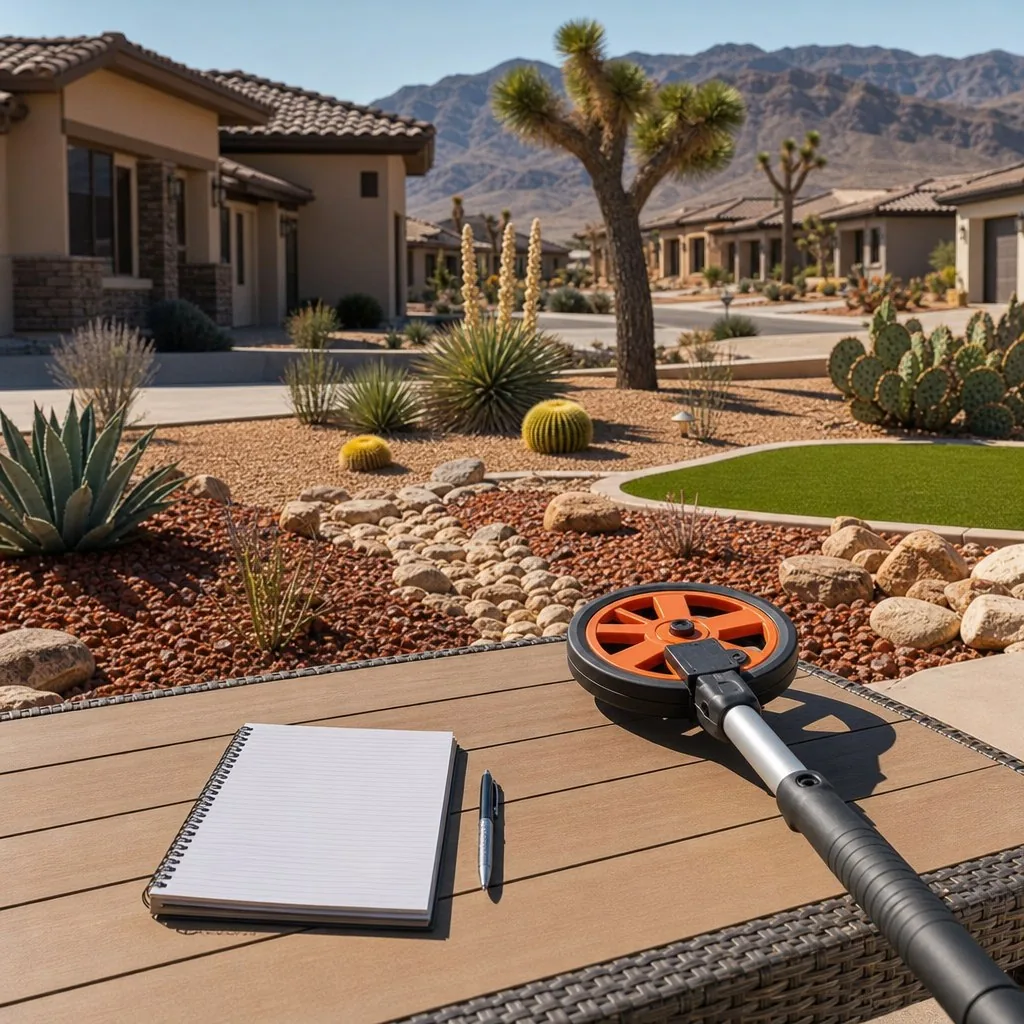
That sorting matters because the rules attach to the bucket, not to the word hardscape. A flat paver path sits in a very different place on the permit ladder than a covered patio with posts set in footings. Writing the list out with rough dimensions is the single most useful thing you can do before collecting bids.
Which hardscape jobs need a building permit in Clark County?
Clark County’s published rules for single-family homes require a building permit for residential perimeter block walls over 24 inches high and for all carports, shade structures and patio covers, free standing or attached. Fences over six feet also need one, and a block wall over six feet needs an administrative deviation from Comprehensive Planning.
Those lines come straight from the county’s building violations page for single-family residential properties, which also says that carports, shade structures, covered patios and room additions built without valid permits are illegal regardless of the age of the structure. Setbacks apply on top of the permit, so a cover that fits your budget can still fail on where it sits on the lot.
Two cautions keep this honest. First, these are the county’s rules. If your address sits inside a city, call that city’s building department before you plan around a county number, because a county threshold is not automatically the city’s. Second, a retaining wall holds back soil and carries different loads than a freestanding wall, so don’t assume the 24 inch figure for a block wall carries over to it. Ask the building department how your wall is classified before you price anything.
The county’s Building Department takes permit questions at (702) 455-3000, and the Comprehensive Planning office answers setback questions at (702) 455-4314. A five minute call with your lot dimensions in hand usually settles which of your items are permit items.
Will hardscape affect my Southern Nevada turf rebate?
Yes, it can. The Southern Nevada Water Authority’s Water Smart Landscapes terms say the converted area must be permeable and covered by mulch such as rock, bark, ungrouted pavers or living groundcover, and that concrete and other impermeable materials aren’t allowed in that area. A concrete patio is simply excluded from the rebate area.
The same terms say that when a project includes something like a concrete patio, that patch is excluded but the surrounding areas may still qualify. So a patio doesn’t kill the rebate, it just doesn’t earn one. What costs people money is putting impermeable material where the rebate measurement was going to happen, or finishing the hardscape before the Authority’s pre-conversion inspection has cleared you to proceed.
The rebate pays $5.00 per square foot on the first 10,000 square feet of grass removed and $2.50 beyond that for single-family residential applicants, and Las Vegas Valley Water District customers can add $2.00 per square foot. At the combined $7.00 rate a 600 square foot front lawn comes to $4,200 back, which is real money sitting next to the patio budget. Do the rebate math on the grass area and the hardscape math on the patio area separately, so neither number hides the other.
One more term worth reading before you sign anything: the Authority’s rebate comes with a conservation easement that restricts certain uses of the converted area in perpetuity. A future pool or a built-over patio on that footprint is exactly the kind of change it addresses.
Who needs a Nevada contractor license to build a patio or wall?
Nevada law defines a contractor as someone who undertakes or offers to construct, alter, repair, add to, improve or demolish any building or other structure, and says all contractors must be licensed before bidding, offering to engage or negotiating a price. For paid hardscape construction, the person you hire needs the right license from the Nevada State Contractors Board.
That definition comes from NRS 624.020 as quoted on the Board’s own license requirements page. The Board sorts licenses into General Engineering (A), General Building (B) and 42 specialty subclassifications under Classification C. Among the A classes the Board lists are A-21 for fencing and guardrails and A-24 for fountains and other water features, which gives you a feel for how narrowly the trades are sliced.
The Board also points out that a license belongs to the business, carries a monetary limit, and shows the classification on the contractor’s pocket card. Contracts written above that limit are invalid. So the questions to ask are specific: which classification covers my work, what is the monetary limit, and will you show me the pocket card.
This page doesn’t price or sell construction. It exists to help you walk into those conversations prepared.
When can a homeowner do hardscape work without a contractor?
Nevada’s exemptions are narrow. NRS 624.031 exempts an owner building or improving a residential structure for their own occupancy, with an application to the Board, and exempts repair or maintenance work valued under $1,000 including labor and materials. The under-$1,000 exemption disappears if a building permit is required or the job is part of a larger project.
Read that second exemption twice, because it is aimed at repair and maintenance, not at new construction. Resetting a few loose pavers in an existing path is the sort of thing it contemplates. Building a new patio isn’t, and the statute adds that it doesn’t apply when a building permit is required, when the work is of a type performed by a plumbing or electrical contractor, or when the work is part of a larger project valued at $500 or more.
The owner-builder route exists, and the Board has an owner-builder information page, but it carries conditions: the property has to be for your own occupancy and not for sale or lease, and the statute presumes otherwise if you sell or lease within one year of completion. If you’re considering doing it yourself, read the Board’s owner-builder page and call its Las Vegas office at (702) 486-1100 before you start rather than after.
How do caliche and soil change a hardscape plan here?
Las Vegas-series soil has a cemented petrocalcic layer documented from about 11 inches down, plus strongly alkaline horizons around pH 8.6. That hard layer affects footing depth, drainage and how much digging a wall or post hole really involves, so it should be written into the scope before bids come in.
Caliche is the local word for that cemented layer, and it is why two yards a few streets apart can produce very different quotes for the same patio cover. A contractor who has never probed your yard is guessing at the digging. Probing a few spots with a steel rod, noting the depth where it stops, and photographing the result gives every bidder the same facts to price against.
Drainage deserves the same treatment. Monsoon storms deliver a lot of water in a short time onto surfaces that don’t let much through, and a hard layer under a paver base can hold water where you didn’t expect it. Walk the yard during or right after a hard rain, note where water pools and where it leaves, and bring that to your site conversation. Our soil and site guide walks through the measurements worth taking.
What does a hardscape project process look like, step by step?
A well-run hardscape project moves from a written scope to permit questions, bids, permit and rebate approvals, construction by a properly licensed contractor, inspection and final payment. The steps below are the homeowner’s side of that sequence, with what you decide at each stage and roughly how long it takes.
- Write the scope and sketch it. List each element with rough dimensions and where it sits on the lot. Decide what is must-have and what is nice-to-have. Plan on a weekend.
- Take site facts. Probe for caliche depth, mark where water pools, note slopes, and locate the sprinkler valves and utility lines you know about. One afternoon.
- Answer the permit questions. Call the building department that covers your address with the dimensions of each element. Ask about permits, setbacks and any deviation for tall walls. Allow a week for call-backs.
- Settle the rebate order of operations. If grass is coming out, apply for the Southern Nevada Water Authority rebate and wait for the pre-conversion inspection before anything is removed. Waits run longer in spring and fall.
- Collect at least three written bids. Give every bidder the same scope and the same site facts, and ask each for their license number and classification. Two to three weeks is typical.
- Verify and compare. Look each license up on the Board’s contractor search, check the classification and monetary limit, and compare scopes line by line instead of by total.
- Sign a written contract and schedule payments. Tie payments to finished work, keep the deposit within the limit the Board describes, and keep every paper in a job file.
- Permit, build, inspect. The contractor pulls permits where required, and inspections happen at the stages the building department sets. Timing depends on scope, and a plain patio is days while a covered structure runs longer.
- Close out. Walk the job, collect lien releases, make the final payment only when you’re satisfied, then call the Water Authority for its post-conversion inspection if a rebate is involved.
How should I budget for hardscape without a contractor quote in hand?
Budget in layers: planning costs first, permit fees next, then the construction bids you collect. Public sources put Las Vegas landscape consultations at $50 to $100 per hour and detailed design drawings at up to $6,000 for larger plans, and one price survey lists permit fees of roughly $150 to $400. Construction pricing comes from your bids.
We aren’t going to print a per-square-foot construction figure here, because the number that matters comes from a written bid against your measured scope, and a generic number invites the wrong expectation. What we can do is name what moves a bid so you can see it coming. Access is the first driver: a gate narrow enough that material has to be carried by hand costs more than a driveway-side pad. Caliche is the second, because every inch of hard digging adds hours. Height and structure are the third, since a tall wall or a covered structure brings engineering, footings and inspections that a flat path doesn’t. Surface choice is the fourth: pavers, poured concrete and flagstone are priced and installed differently, and only some of them play nicely with a rebate area.
The rebate is the other half of the budget picture. On a 400 square foot front lawn, the combined SNWA and Water District rate comes to $2,800, and the Authority says most applicants finish their conversions within 60 days. Our Las Vegas pricing guide lays the rebate tiers out in detail.
How do I compare bids and protect my payments?
Get at least three written bids on the same scope, ask each contractor for a license number and classification, and be wary of a bid far below the others. The Board also says the down payment cannot exceed $1,000 or 10 percent of the contract price, whichever is less, unless the contractor posts a $100,000 consumer protection bond.
The Board’s guidance adds a short list worth taping to the fridge. Don’t pay in cash. Don’t let payments get ahead of the work. Keep a record of every payment and a job file with every paper. Don’t make the final payment until you are satisfied with the job.
Liens are the quiet risk on construction jobs. Under Nevada’s mechanics’ lien statutes, a contractor, subcontractor or supplier who furnishes $500 or more of work or materials and isn’t paid can place a lien on your property, even if you paid your contractor in full. The Board’s notice to owners says the maximum time to file is generally 90 days after substantial completion, and it suggests asking for unconditional lien release forms with each payment, using joint checks, or asking for a payment and performance bond, which it says usually costs 1 to 6 percent of the contract.
Finally, the Board states that a contract with an unlicensed contractor is null and void by law and that homeowners who use unlicensed contractors aren’t eligible for the Residential Recovery Fund. The lowest bid is a bad deal if it comes from someone the law doesn’t recognize.
What does a typical hardscape scope look like in the valley?
Three typical scopes show how the pieces combine. They are illustrations of how people scope jobs, not records of finished work, and none carries a construction price. Use them to see which permit and rebate questions attach to which kind of project.
A typical Summerlin backyard patio. A paver patio of roughly 300 square feet off the back door, with a short flagstone path to a side gate. Permit question: probably none for flat surfaces, but confirm at the building department. Rebate question: the patio sits outside any lawn conversion area, and the path should use ungrouted pavers or stone set on permeable base if it crosses the converted area. Main risk: drainage toward the house.
A typical Henderson front yard conversion with a seat wall. A 900 square foot front lawn replaced with rock, drip-irrigated plantings and a low block seat wall under 24 inches. Permit question: the wall height stays under the county’s 24 inch trigger, but confirm which jurisdiction applies. Rebate question: the wall is not part of the rebate area, but the conversion around it is. Main risk: removing grass before the pre-conversion inspection.
A typical Spring Valley shade structure. A freestanding patio cover over an existing slab. Permit question: yes, the county lists all patio covers as permit items, with setbacks. Contractor question: this is a construction job, so license and monetary limit matter. Main risk: starting without a permit, because structures built without one are illegal no matter how long they stand.
Where in the valley does this planning guidance apply?
The licensing rules are statewide, the water rules and rebate apply across Southern Nevada, and the permit rules depend on which building department covers your address. We cover homeowners across the valley, including Summerlin, Henderson, North Las Vegas, Spring Valley and Enterprise.
Neighborhood differences are worth a short call. Newer master-planned communities often add an HOA review on top of the building department, and older parts of the valley such as Paradise and Sunrise Manor can have different lot shapes and access that change how a patio or wall fits. Tell whoever you call which community you’re in, and ask whether an HOA architectural review comes before or after the permit.
What should I ask a hardscape contractor before signing?
Ask for the license number and classification, the monetary limit, who pulls the permit, who is on site, what the payment schedule is tied to, and how drainage and caliche are handled in the price. A contractor who answers all of that in writing is easier to compare than one who answers by phone.
A few more questions pay for themselves. Ask how a change in scope is priced before work starts, since change orders are where budgets drift. Ask whether the price assumes the caliche depth you measured. Ask what happens to the sprinkler or drip lines that run through the work area, and who is responsible if one is cut. If you’re pairing hardscape with a turf conversion, ask whether the contractor knows the Water Authority’s drip and permeable-surface conditions, because the inspection is picky about visible filters and regulators.
It also helps to read how we suggest choosing a landscaper and how permits and project planning fit together on our site. When your list is ready, call (702) 766-4082 or send it through the free quote form and we’ll help you sort which items are permit items and what to ask next.